
How to Order Custom Furniture from Bali: A Step-by-Step Guide for International Buyers


Most guides to ordering custom furniture from Bali are written for people who are physically there — visiting workshops, inspecting samples in person, and shipping a container back home. But what if you're in London, Miami, or Sydney and you've never set foot in Bali?
But the majority of Azula Designs' clients are abroad. They've never set foot in Bali. But they realize that handcrafted Indonesian furniture is better quality, more precisely specified, and more affordably priced than anything they could have sourced in their home countries. They also realize getting those pieces in their front door is no easy task. Thankfully, we have the answers foryou.
This guide explains exactly how to do it — the full process from initial brief to furniture arriving at your home, step by step, with no surprises along the way.
Who This Guide Is For
This process works for:
Homeowners furnishing a new home or renovation who want quality custom pieces that can't be found in local showrooms.
Interior designers sourcing custom furniture for client projects — particularly for hospitality, villa, or high-end residential briefs.
Property developers fitting out multiple units or rooms and needing consistent quality at volume.
Airbnb and short-stay hosts who want furniture that photographs well, performs in use, and differentiates their listing
If you've never ordered custom furniture internationally before, this process will feel more straightforward than you expect. If you've done it before with a less organised supplier, this will be noticeably different.
The Full Process: From Brief to Delivery
Step 1 — Define What You Need
Before you contact any supplier, get clear on your requirements. The more specific you can be at this stage, the faster and more accurately a supplier can quote — and the lower the chance of surprises later.
What to prepare:
A list of pieces — What do you want made? A dining table, four chairs, a bed frame, a sideboard? List each piece separately.
Dimensions — For each piece, what are your size requirements? Measure your space carefully. Note ceiling height for tall pieces, doorway widths for anything that needs to fit through an entrance, and the footprint available.
Material preference — Do you have a preference for teak, mahogany, bamboo, rattan, or suar wood? If you're not sure, note the environment the piece will live in (indoor, outdoor, humid climate, dry climate) and a good supplier will advise.
Finish preference — Natural oil, matte wax, stained finish, painted? If you have a colour reference, a RAL or Pantone code is the clearest way to communicate it.
Reference images — Save 3–5 images from Pinterest, Instagram, or design magazines that capture the aesthetic you're going for. You don't need to know the exact style name — images communicate more clearly than words.
Timeline — When do you need the furniture? Work backwards: if you have a move-in date or a project deadline, factor in 6–11 weeks of production and 3–5 weeks of shipping minimum.
Pro tip: Don't worry about having everything perfectly figured out at this stage. A good supplier will refine the brief with you. But the more you bring to the first conversation, the better the outcome.
Step 2 — Find and Vet a Supplier
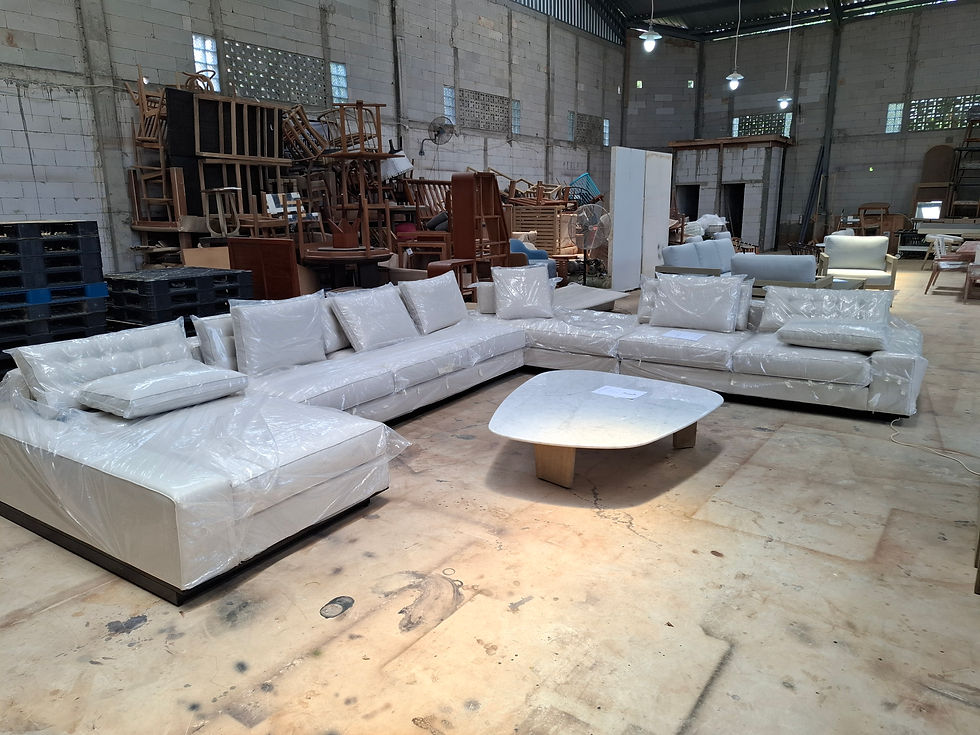
Not all Bali furniture suppliers are equal — and the distance involved in international ordering means that quality control, communication, and reliability matter more than they would if you were buying locally.
What to look for:
SVLK or FSC timber certification. This is Indonesia's mandatory timber legality assurance system. Any reputable exporter will have it. If a supplier can't provide documentation, walk away — not only is it an ethical issue, but uncertified timber can cause customs problems on arrival, particularly in the EU, USA, and Australia.
Export experience. Ask specifically how many international containers they've shipped and to which countries. A supplier experienced in exporting to your destination country will know the documentation requirements, the common customs issues, and the right freight forwarders to use.
Production transparency. Can they show you the workshop where your furniture will be made? Can they send photos during production? A supplier who resists this is a red flag.
References or portfolio. Ask for photos of completed orders similar to yours. Any established exporter will have these readily available.
Clear communication. Responsiveness, clarity, and the ability to answer specific technical questions (timber moisture content, finish specifications, packaging methods) are good indicators of how the production process will be managed.
At Azula Designs, we work exclusively with a network of vetted partner workshops in Bali and Java that we've built relationships with over years of production oversight. We inspect pieces before export and manage the full documentation process on your behalf.
Step 3 — Submit Your Brief and Receive a Quote
Once you've chosen a supplier, submit your brief. A comprehensive brief at this stage saves significant time and prevents misunderstandings later.
What a good quote should include:
Per-piece price for each item
Material and finish specifications for each piece
Production timeline (start date to completion)
Packaging method (crating, foam wrapping, stretch film)
Export documentation included (SVLK, Certificate of Origin, packing list, commercial invoice)
Estimated shipping cost to your destination (or a referral to a freight forwarder)
Payment terms
What to watch out for:
Be cautious of quotes that don't specify materials clearly, that include vague "approximately" timelines, or that provide a single lump-sum price without itemisation. A legitimate supplier will be transparent at this stage because their reputation depends on delivering what was agreed.
Step 4 — Review Samples and Approve the Design

For first-time orders — or for pieces with specific finish requirements — request material samples before production begins. A reputable Bali supplier will send physical timber samples, finish swatches, and fabric or upholstery samples if relevant.
For larger or more complex orders:
Ask for a 3D render or technical drawing before production starts. This is standard practice for trade buyers and interior designers and eliminates the risk of misunderstandings. At Azula Designs, we provide this for all custom orders as standard.
Approval checkpoint:
Don't allow production to begin until you have reviewed and signed off on:
Final dimensions
Material and finish specification
Design drawing or render (for complex pieces)
Total price including all agreed costs
Once production starts, changes become expensive and time-consuming. The approval stage is the moment to get everything right.
Step 5 — Production

Custom furniture from Indonesia typically takes 6–11 weeks from production start to completion, depending on complexity and current workshop load. During this period, a good supplier will:
Provide a production start confirmation
Send progress photos at key milestones (timber selection, frame completion, finishing stage)
Flag any issues early — material availability, finish adjustments, timeline changes
What you should do during production:
Confirm your shipping address and any specific delivery requirements (ground floor only, narrow access, elevator dimensions for apartment deliveries)
Arrange marine cargo insurance — strongly recommended for any international furniture shipment. Typically costs 1–2% of the cargo value and covers loss or damage in transit
Begin the conversation with a customs broker in your country if you haven't already — particularly for larger orders or first-time imports
Step 6 — Pre-Shipment Quality Inspection
Before your furniture leaves Bali, a thorough quality inspection should be carried out. This is the last point at which problems can be fixed without high cost or delay.
What the inspection should cover:
Dimensions match the approved specification
Finish is consistent and matches the approved sample
Joinery is solid with no gaps, wobbles, or loose connections
No surface damage — scratches, dents, staining, or uneven finish
Hardware (hinges, handles, drawer runners) operates correctly
Upholstery (if applicable) is clean, correctly tensioned, and seam-finished properly
At Azula Designs, we conduct pre-shipment inspection at the workshop for every order and send a full photo report to the client before packaging begins. If anything doesn't meet the specification, it's corrected before the furniture is crated — not after it arrives at your door.
Step 7 — Packaging and Export Documentation

Proper packaging is non-negotiable for international furniture shipments. Damage during sea freight is almost always the result of inadequate packaging rather than rough handling.
Learn more about the commercial process for teak furniture export in this complete guide.
Standard packaging for sea freight:
Individual pieces wrapped in stretch film or cardboard
Foam padding on all corners and protruding elements
Timber crating for fragile or high-value pieces
Silica gel sachets inside crates to manage moisture during transit
Export documentation you should receive:
Commercial invoice (itemised, with declared value)
Packing list (dimensions and weight of each carton/crate)
Bill of Lading (issued by the shipping line)
Certificate of Origin (Indonesia)
SVLK certificate (timber legality)
Fumigation certificate (required for wooden goods entering Australia, USA, and some other markets)
Phytosanitary certificate if required by your destination country
Keep all of these documents. Your customs broker will need them for clearance, and they're your legal record of the shipment in case of any insurance claim.
Step 8 — Shipping and Customs Clearance
Choosing your shipping method:
For most international furniture orders, sea freight is the right choice — significantly cheaper than air freight and perfectly appropriate for non-urgent deliveries.
LCL (Less than Container Load): Your furniture shares a container with other cargo. Suitable for smaller orders (under 10–12 CBM). More flexible but slightly higher cost per CBM than FCL.
FCL (Full Container Load): You fill an entire 20ft or 40ft container. More cost-effective for larger orders (a 20ft container holds approximately 25–28 CBM).
Transit times:
Bali → Europe: 25–35 days sea transit
Bali → USA East Coast: 28–35 days
Bali → USA West Coast: 18–22 days
Bali → Australia: 10–18 days
Customs clearance:
Appoint a licensed customs broker in your destination country. They will handle the import declaration, pay any applicable duties and taxes on your behalf, and arrange release of your cargo from the port.
Duties vary by country and product category.
Step 9 — Last-Mile Delivery
Port clearance is not the same as delivery to your door. Once your furniture clears customs, it needs to be transported from the port to your address — this is called last-mile delivery, and it's a separate cost and arrangement.
Options:
Your customs broker may offer a delivery service
Independent freight forwarders and logistics companies offer final delivery
For large or heavy pieces, specialist furniture delivery companies with two-person teams are worth the extra cost
Before delivery day:
Confirm the delivery team knows the access situation (stairs, elevator, narrow corridors)
Clear the space where each piece will go
Have someone present to inspect each piece on arrival — note any damage on the delivery receipt before signing
Step 10 — Receive, Inspect, and Enjoy
When your furniture arrives, unpack each piece carefully and inspect it against the original specification and the pre-shipment photos.
If you notice damage:
Document it immediately with photos, note it on the delivery paperwork, and contact your supplier and insurance provider the same day. Most reputable suppliers will work with you to resolve genuine transit damage — but documentation at the point of delivery is essential for any claim.
If everything is as expected:
Most clients who order custom furniture from Bali for the first time are surprised by the quality relative to the price — and most place a second order within twelve months.
Why Order Through Azula Designs Rather Than Direct?
You can order direct from an Indonesian workshop. Many people do. But there are meaningful advantages to working through a sourcing partner with established supplier relationships and international shipping experience:
Vetted workshops — We only work with manufacturers we have direct production relationships with and have quality-checked over multiple orders
Design expertise — We can advise on material selection, proportions, and finishes to make sure the pieces work in your space, not just in the workshop.
Quality control — We inspect every order before it ships
Documentation management — We handle all export paperwork, so you're not navigating Indonesian export bureaucracy remotely
Single point of contact — One person manages your order from brief to delivery, not a chain of intermediaries
Frequently Asked Questions
Do I need to visit Bali to order custom furniture? No. The majority of Azula Designs' international clients order entirely remotely — via email, WhatsApp, video call, and reference images. We manage everything from our end so you never need to leave your time zone.
What is the minimum order size? There is no minimum order quantity at Azula Designs. We work with individual homeowners ordering a single piece as well as developers ordering full container loads. That said, ordering multiple pieces in one shipment significantly reduces the per-piece shipping cost.
How do I pay? Standard payment terms for custom furniture from Indonesia are typically 50% deposit to start production and 50% balance before shipment. We accept international bank transfer and major payment platforms.
What if my furniture arrives damaged? Pre-shipment inspection and proper packaging minimise this risk significantly. In the rare event of transit damage, we support clients through the insurance claim process and work to resolve any issues as quickly as possible.
Can I see the furniture before it's shipped? Yes — we send a full pre-shipment photo report before packaging begins, so you can verify every piece against the specification before it leaves Bali.
How long does the whole process take? From brief submission to furniture arriving at your door, allow 12–16 weeks for most international orders. This includes production (6–10 weeks), sea transit (3–5 weeks), and customs clearance (3–7 days).
Ready to start your order? Book a free consultation with Azula Designs and we'll walk you through the process for your specific project.


Comments